Beat Rate Explained: What Vibrations Per Hour Mean in a Watch
Beat Rate Explained: What Vibrations Per Hour Mean in a Watch
This post contains affiliate links. We may earn a commission if you purchase through our links, at no extra cost to you. As an Amazon Associate, I earn from qualifying purchases.
A mechanical watch advertised at 36,000 vibrations per hour sounds more capable than one running at 21,600. On the wrist, the most obvious difference is the second hand: it takes more, smaller steps. Whether that is worth paying for depends on the movement, its power reserve, and what you expect from the watch.
This is a specifications-based buyer’s guide, not a hands-on review. The prices below are approximate US new-watch bands, not live quotes; confirm the current price and exact reference before buying.
What does vibrations per hour mean in a watch?
Vibrations per hour (vph) count the balance wheel’s half-oscillations in one hour. Divide vph by 7,200 to get hertz: 28,800 vph equals 4 Hz, or four complete oscillations per second. Higher frequency produces more second-hand steps, but it does not guarantee better accuracy or durability.
How beat rate changes what you see
The balance wheel swings back and forth while the escapement releases the gear train in measured increments. Each half-swing is one vibration and usually advances the second hand one step. A 21,600 vph movement therefore makes six steps per second; a 28,800 vph movement makes eight; a 36,000 vph movement makes ten. None produces a truly continuous sweep.
Those differences are visible if you look for them, especially with a long second hand. They are less consequential when you glance at a watch to catch a train. The 3 Hz hand on a Seiko 5 Sports SRPD55 is still unmistakably mechanical; the 5 Hz hand on a Zenith Chronomaster Sport moves in finer increments. Neither tells you, by sight alone, which watch keeps better time over a week.
Beat rate also needs to be kept separate from amplitude. Beat rate describes how often the balance oscillates. Amplitude describes how far it swings. A watchmaker can measure amplitude and beat error on a timing machine to help diagnose a movement, but a high advertised frequency cannot make up for poor regulation, inadequate lubrication, or a fault in the escapement.
Five factors that matter more than the biggest vph number
The complete movement matters. A higher beat rate gives the escapement more opportunities to divide time, which can help a well-designed movement resist some disturbances. It also makes more cycles per day. Materials, lubrication, regulation, and the energy supplied by the mainspring all affect the result. Treat 5 Hz as a design choice, not an accuracy certificate.
Power reserve is a separate specification. A faster balance generally asks more of the movement’s energy budget. Makers can compensate with changes to the barrel, mainspring, and gear train, so you cannot calculate reserve from frequency alone. The Zenith Chronomaster Sport’s El Primero 3600 pairs 36,000 vph with an approximately 60-hour reserve. The 21,600 vph Tissot PRX Powermatic 80 offers about 80 hours. If you put a watch down on Friday and want it running on Monday, that difference may matter more than the second-hand sweep.
Published accuracy needs context. Seiko specifies the 4R36 in the Seiko 5 Sports SRPD55 at roughly −35 to +45 seconds per day under its stated conditions. That is a tolerance, not a prediction that every example will drift by that much. COSC certification applies a tighter −4 to +6 seconds-per-day criterion to the movement under its test conditions. METAS Master Chronometer testing evaluates the completed watch against its own standards, including a 0 to +5 seconds-per-day criterion. Certification, adjustment, and a watch’s condition tell you more about expected timekeeping than vph alone.
Service costs deserve a place in the budget. More oscillations mean more escapement activity, but they do not establish that a particular high-beat watch will wear out first or need a shorter service interval. Lubrication and friction matter, as do the movement’s design and condition. A service on a sophisticated high-beat chronograph can cost substantially more than work on a common three-hand movement. Ask about the maker’s service guidance and the price of work on the specific calibre, especially when buying pre-owned.
The case still has to fit. A smooth sweep will not rescue a watch whose lugs overhang your wrist or whose thickness catches every cuff. Compare diameter, thickness, lug-to-lug length where the maker supplies it, water resistance, and strap or bracelet before paying extra for frequency. For that broader choice, Tool Watch or Dress Watch: Choosing Your Daily Driver is a useful question to settle alongside the movement spec. Tool Watch vs. Dress Watch: Choosing the Daily Driver addresses the same practical trade-off from the watch’s role on the wrist.
Five watches that put beat rate in context
The table compares published specifications for the stated references. Price bands are broad guides to new US retail, not promises of stock or a current offer. Confirm dimensions and pricing on the exact version you intend to buy.
| Product and reference | Case and movement | Beat rate; second-hand steps | Power reserve | Approximate new US price |
|---|---|---|---|---|
| Seiko 5 Sports SRPD55 | 42.5 mm case; 4R36 automatic | 21,600 vph / 3 Hz; six per second | About 41 hours | $300–$400 |
| Hamilton Khaki Field Mechanical H69439931 | 38 mm case; H-50 hand-wound | 21,600 vph / 3 Hz; six per second | About 80 hours | $500–$700 |
| Tissot PRX Powermatic 80 T137.407.11.041.00 | 40 mm case; Powermatic 80 automatic | 21,600 vph / 3 Hz; six per second | About 80 hours | $700–$900 |
| Sinn 556 I | 38.5 mm case; SW200-1 automatic | 28,800 vph / 4 Hz; eight per second | About 38 hours | $1,500–$2,000 |
| Zenith Chronomaster Sport 03.3100.3600/69.M3100 | 41 mm case; El Primero 3600 automatic chronograph | 36,000 vph / 5 Hz; ten per second | About 60 hours | $10,000–$12,000 |
Seiko 5 Sports SRPD55: the affordable 3 Hz baseline
The Seiko 5 Sports SRPD55 is a useful place to learn what 21,600 vph looks like without paying for a specialist movement. Its 42.5 mm case is 13.4 mm thick, with a 46 mm lug-to-lug length, and it has 100 m water resistance. The 4R36 offers automatic winding, hand-winding, hacking seconds, and a day-date display.
It wins on accessible pricing and a movement that is widely understood by repairers. Its compromises are the relatively short reserve and a broad published accuracy tolerance. If you care more about keeping close time than about seeing six versus eight steps per second, budget for a timing check and ask what adjustment is available rather than assuming a faster watch will solve the problem.
Hamilton Khaki Field Mechanical H69439931: reserve over sweep
The Hamilton Khaki Field Mechanical H69439931 has a 38 mm case and an H-50 movement that runs at 21,600 vph. It is hand-wound, so its roughly 80-hour reserve is particularly useful: you can wind it on a regular schedule without treating every missed day as a reset. Its 50 m water-resistance rating makes it a field-style daily watch, though it is not the pick here for regular swimming.
It wins for someone who wants a smaller, straightforward watch and enjoys winding it. You give up automatic winding and the finer visual sweep of a 4 Hz or 5 Hz calibre. Check the exact strap and case dimensions offered by the seller; a familiar model name can cover more than one version.
Tissot PRX Powermatic 80 T137.407.11.041.00: a long-reserve automatic
The Tissot PRX Powermatic 80 T137.407.11.041.00 pairs a 40 mm steel case with an automatic movement running at 21,600 vph and an approximately 80-hour reserve. It is rated to 100 m. The integrated bracelet is central to the design, and its effective fit depends on how the first links sit beyond the case, so a diameter figure alone is a poor substitute for a wrist check.
This is the clearest counterexample to buying by beat rate: its three-day-plus reserve is a tangible convenience, even though its second hand makes fewer steps than the Sinn 556 I. The compromise is limited strap flexibility compared with a watch using conventional lugs. Try the bracelet, or confirm the fit and return terms, before choosing it for its movement spec.
Sinn 556 I: the conventional 4 Hz choice
The Sinn 556 I uses a 38.5 mm case, is rated to 200 m, and runs a SW200-1 automatic movement at 28,800 vph. That gives its second hand eight steps per second. Its roughly 38-hour reserve is adequate for a watch worn daily, but it is easy to stop if left aside for a full weekend.
It wins for a buyer who wants a restrained dial, substantial water resistance, and a widely familiar movement architecture. The price is considerably higher than the Seiko 5 Sports SRPD55, while the reserve is shorter than either 80-hour pick. Buy the whole watch, including its case and dial, rather than treating 4 Hz as the upgrade you are paying for.
Zenith Chronomaster Sport 03.3100.3600/69.M3100: high beat with a purpose
The Zenith Chronomaster Sport 03.3100.3600/69.M3100 uses the El Primero 3600, a 36,000 vph automatic chronograph movement with an approximately 60-hour reserve. The 41 mm case is rated to 100 m. Its high frequency also supports the chronograph’s prominent display of tenths of a second; here, beat rate is part of a complication you can actually use and read.
It wins if you want that chronograph design and function. It is a poor value proposition if your only goal is a smoother running-seconds hand: the purchase price and potential chronograph service bill are large commitments for a small visual difference. Ask for the exact reference and service documentation when comparing new, unworn, and pre-owned examples.
How these movements compare beyond the five picks
The five watches span three familiar frequencies, but other calibres help explain why the number alone is a weak shopping filter. The Grand Seiko Hi-Beat 9S85 runs at 36,000 vph, like the Zenith El Primero 3600, with a roughly 55-hour reserve. The Zenith is a chronograph movement; the 9S85 is a different solution to a different brief. Matching beat rates do not make the watches interchangeable.
At 28,800 vph, the ETA 2824-2 and Miyota 9015 each give eight second-hand steps per second. They differ in construction, specifications, and the watches built around them. At 21,600 vph, the Seiko Caliber NH35A is widely used in affordable automatics and offers around 41 hours of reserve. A watch built around an NH35A can be the sensible purchase if its case fits and its price leaves room for service. Do not dismiss it because a more expensive movement produces two extra hand steps per second.
Most of these movements use forms of the Swiss lever escapement. A co-axial escapement uses a different impulse arrangement intended to change how sliding friction is handled. Co-axial versus lever is an escapement-design comparison, not a shortcut for ranking watches by frequency: either design still depends on appropriate lubrication, sound adjustment, and maintenance.
What to skip, and how to buy
Skip any listing that sells “high beat” as a complete answer to accuracy. Ask for the actual calibre and its published frequency, reserve, and accuracy standard. Also skip a pre-owned watch advertised as recently serviced if there is no dated documentation of the work. A timing-machine photo can be useful, but one reading in one position does not establish how the watch performs across a day on the wrist.
For a first mechanical watch, start with case fit, water resistance, and the cost of ownership you can accept. The Seiko 5 Sports SRPD55 keeps the entry price modest; the Hamilton Khaki Field Mechanical H69439931 trades automatic winding for a long reserve; the Tissot PRX Powermatic 80 T137.407.11.041.00 gives that long reserve in an automatic. Choose the Sinn 556 I if its overall design and 200 m rating justify the jump. Choose the Zenith Chronomaster Sport 03.3100.3600/69.M3100 for its chronograph, not for ten running-seconds steps in isolation.
Buy new from an authorized dealer when warranty and a clear return route matter most. For a pre-owned high-beat watch or chronograph, request service records, check that every function operates, and get a service estimate before treating the asking price as your total cost.
FAQ
Is 28,800 vph the same as 4 Hz?
Yes. A 4 Hz balance makes four complete back-and-forth oscillations per second. Each complete oscillation contains two vibrations, giving 28,800 vibrations per hour and, typically, eight second-hand steps per second.
Is a 36,000 vph watch more accurate than a 21,600 vph watch?
Not necessarily. Frequency is one part of movement design. Regulation, position, temperature, lubrication, and condition affect daily performance. Compare the maker’s stated tolerance or a relevant certification, then assess the individual watch.
Does a faster beat rate wear out a movement faster?
A faster movement completes more cycles, but cycle count alone does not establish its service interval. Escapement design, materials, lubrication, and the quality of maintenance matter. Compare service guidance and costs for the particular calibre.
Why does a 3 Hz mechanical second hand still look smooth?
It advances six times each second, far more often than the once-per-second jump of a typical quartz watch. A 4 Hz or 5 Hz hand takes smaller, more frequent steps, though all three remain stepped rather than continuous.
Should I choose power reserve or beat rate?
Choose the feature you will use. An 80-hour reserve helps if you rotate watches over a weekend. A higher beat rate changes the look of the second hand and may serve a specific complication. Neither replaces good fit or suitable water resistance.
This article contains affiliate links. Case & Strap may earn a commission when you purchase through them, at no additional cost to you.
This article contains affiliate links. Case & Strap may earn a commission when you purchase through them, at no additional cost to you.
Related Articles
- The Best Watches for Small Wrists Under $1500: 36mm and Under That Wear Right
- The Best Sapphire Crystal Watches Under $500: A Hands-On Buyer's Guide
- How to Set and Read a GMT Watch
- How to Use a Dive Watch Bezel: A Complete Guide for Enthusiasts
- Seiko vs Citizen: The Ultimate Head-to-Head Watch Brand Comparison
Keep reading
- notes on tool watch dress choosing
- notes on determines watch resale
- Tool Watch vs. Dress Watch: Choosing the Daily Driver
Where to Buy
- Seiko 5 Sports SRPD55 on Amazon
- Hamilton Khaki Field Mechanical H69439931 on Amazon
- Tissot PRX Powermatic 80 T137.407.11.041.00 on Amazon
- Sinn 556 I on Amazon
- Zenith Chronomaster Sport 03.3100.3600/69.M3100 on Amazon
- Watch Gang
Affiliate links: as an Amazon Associate and partner of the stores above we earn from qualifying purchases.
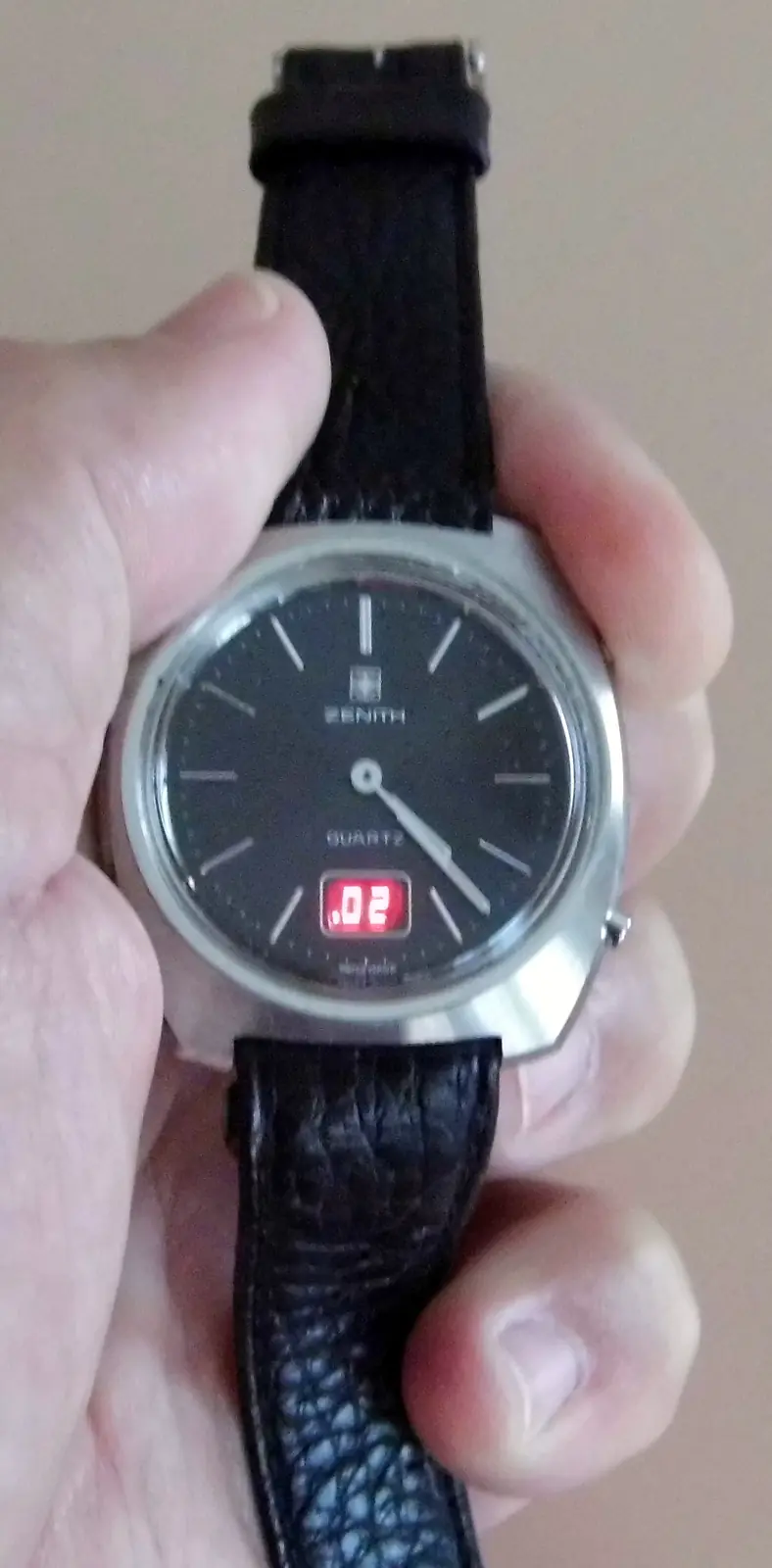
Image credit: photo by Joe Haupt from USA via Wikimedia Commons, licensed CC BY-SA 2.0.
